Looking back at the Scientific Day
30 Sep 2026
event,
research,
maritime
cybersecurity
On September 24, 2026, the Naval Cyberdefense Chair organized, with the support of the Pôle d’Excellence Cyber, a scientific day in Cesson-Sévigné dedicated to the progress of its work. Doctors, PhD students, and industrial partners looked back on 12 years of research.
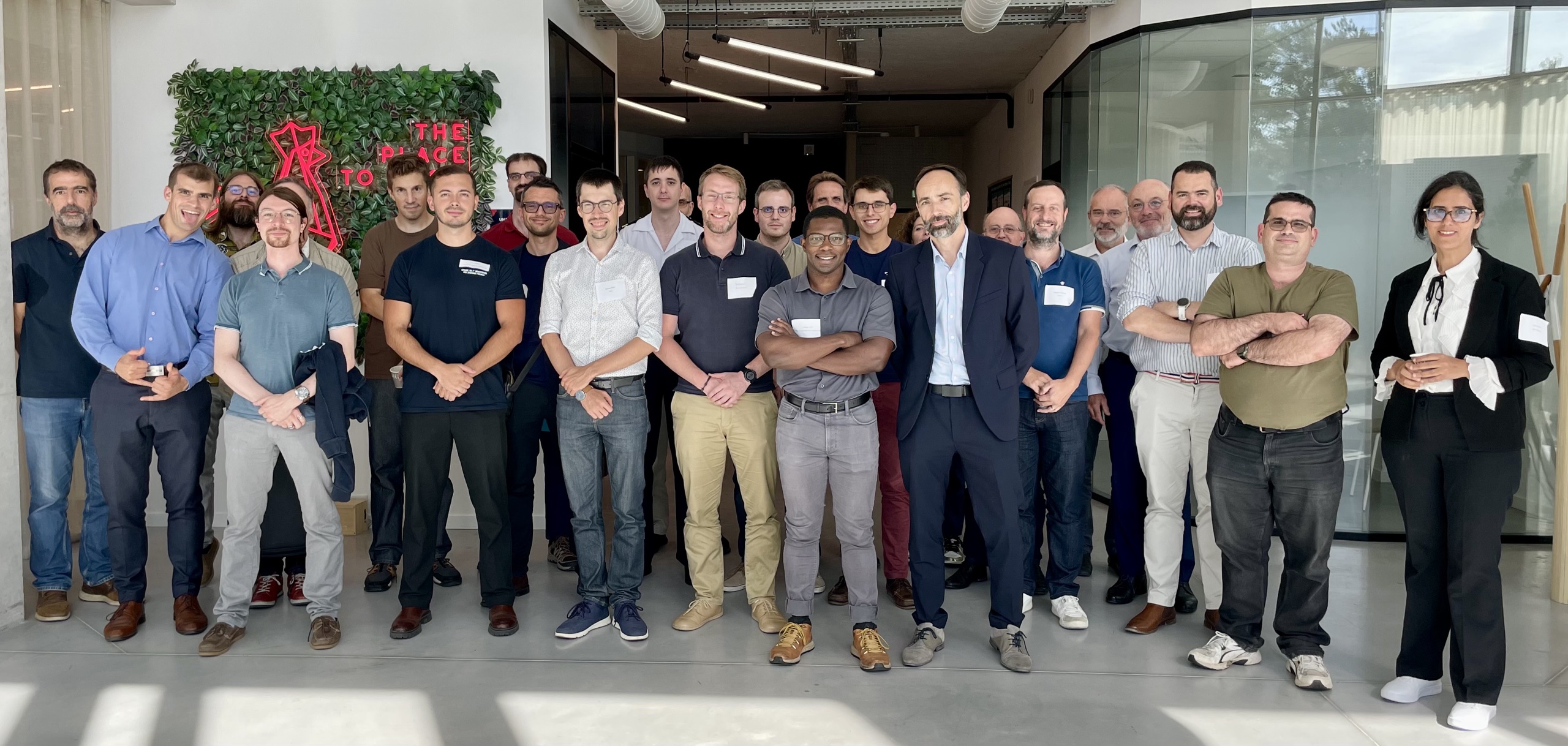
Opening: Presentation of the Chair
Speakers: David Brosset, researcher at the Naval Academy and holder of the chair, and CF Jean-Baptiste Mençon, cyber coordinator, Navy Staff
The day opened with a presentation of the Chair, its missions, and its team. Created in 2014, it combines academic research, teaching, and awareness-raising to contribute to the cybersecurity of the civilian and military maritime world. The presentation also recalled its academic and industrial consortium, its communication channels, and its scientific outreach.
David Brosset’s presentation:
During his address, CF Jean-Baptiste Mençon recalled the central role of cyberdefense in naval operations and the importance of the chair in preparing the Navy for digital challenges and technological disruptions:
“Cyberdefense is not a technical add-on: it is an essential component of our ability to operate at sea."
From data quality to multidisciplinary research
Speaker: Pedro Merino Laso
Pedro Merino Laso traced the work carried out within the Chair on anomaly detection through data quality analysis. His presentation showed how this research has expanded towards a multidisciplinary approach, mobilizing data science in service of maritime challenges as part of his current duties at the École nationale supérieure maritime.
Presentation:
Convergence between formal methods and LLMs for critical systems design
Speaker: Bastien Sultan
Bastien Sultan explored how large language models can support the design of critical systems based on model-driven engineering. He discussed their use in suggesting modifications, updating properties, and detecting inconsistencies. Formal methods can then help frame and verify the generated results. The presentation also covered an implementation of these approaches in the TTool tool, developed at Télécom Paris.
Presentation:
Generating realistic data to detect anomalies
Speaker: Clet Boudehenn
Clet Boudehenn presented the challenges of intrusion detection in naval cyber systems, where realistic data is important for studying anomalies and attacks. His talk explained the value of generating such data, with a research approach geared towards operational needs.
Presentation:
PhD student pitches and poster session
Speakers: Chair PhD students
The PhD students presented their work during pitch sessions, and discussions continued around posters over lunch. These two sessions provided an opportunity to discover the diversity of research topics and to engage directly with those conducting them.
Learn more about ongoing PhD theses.
Industrial partner presentations
Speakers: Marc Pennamen, Thales SIX and Éric Weber, Naval Group
The industrial partners shared their perspectives on naval cybersecurity challenges.
Marc Pennamen from Thales addressed future challenges such as dynamic trust in tactical data exchanges, access rights management and cryptographic elements, as well as avenues such as federated learning for detection and differential privacy.
On Naval Group’s side, Éric Weber commended the Chair’s 12 years as a pioneer in naval cybersecurity. He also highlighted the extreme socio-technical complexity of military vessels and the direct value of research work applied to systems deployed at sea. Faced with increased state-sponsored threats and artificial intelligence lowering the technical barrier for attackers, perimeter defense is no longer sufficient. The new paradigm is now based on Zero Trust-inspired resilience, allowing a compromised zone to be isolated in order to guarantee, under all circumstances, the continuity of the operational mission.
Maritime Cyber Situational Awareness: leveraging incident data
Speaker: Olivier Jacq
Olivier Jacq presented a dataset dedicated to public maritime cyber incidents, developed and enriched as an extension of his doctoral work. He showed how this corpus can help characterize the threat and support the sector’s protection, detection, and resilience. He also outlined the limitations of the exercise: underreporting, the absence of a denominator to relate incidents to a population, differences in severity, and the influence of evolving collection methods on the corpus’s growth.
Presentation:
Human vulnerability in socio-technical systems
Speaker: Paul Perrotin
Paul Perrotin presented work that considers the human operator as a full-fledged component of socio-technical security systems. This work proposes a method for modeling the architecture of these systems and assessing their vulnerability to attacks, as well as how such vulnerability propagates. The approach relies in particular on a Bayesian network built from influence rules drawn from the humanities and social sciences.
Presentation:
My cryptography in the 21st century - From saltwater to post-quantum
Speaker: Guillaume Bonnoron
Guillaume Bonnoron looked back on his journey in cryptography, from his first discoveries and training at Télécom Bretagne to his work within the Naval Cyber Chair. He then offered two perspectives: the place of cryptography within a company and the challenges of post-quantum cryptography.
Presentation:
Control flow exploitation and embedded systems protection
Speaker: Étienne Louboutin
Étienne Louboutin walked through the steps leading from source code to compiled binary, then explained the principle of control flow hijacking and ROP (Return-Oriented Programming). He illustrated his talk with the example of a public proof of concept associated with CVE-2026-46242, before discussing the protections available.
Presentation:
Conclusion
The scientific day illustrated the variety of the Chair’s work and the links between academic research, operational needs, and industrial expertise. From discussions on data and critical systems to consideration of the human factor and developments in cryptography, the talks helped share the research avenues that contribute to the cybersecurity of the maritime and industrial world.
Acknowledgements
All the speakers, doctors, PhD students, industrial partners, academic supervisors, and the teams of the Pôle d’Excellence Cyber and CyberPlace.